Confidence, thresholds and calibration
Written by Jakub Rusinowski · Last updated
A decision model's probabilities are only useful if a 0.9 is right about 90% of the time. That property is called calibration, and you have to measure it on your own data — Ollama's confidence field does not measure it. Label 100–300 real examples, run them through the model, and set three bands: accept automatically, send to a bigger model or a human, and abstain. This page shows how, with a script you can run tonight.
Three different numbers people call "confidence"
| Number | Where it comes from | What it tells you |
|---|---|---|
probabilities | Every choice and score answer; noul is the probability of true | The model's belief spread across your options |
confidence (Ollama) | Ollama computes 1 − H(p) / ln(N) — one minus the normalised entropy of the probabilities | How peaked the distribution is. 0 = all options equally likely; near 1 = one option dominates |
| Calibration | You measure it: compare stated probability with how often the model was actually right | Whether you can trust the probabilities at face value |
Ollama's API reference is explicit that confidence is "not calibrated correctness", and its decision guide adds that "a higher value does not guarantee the answer is correct." TypeSafe markets its hosted Jev as calibrated and trains for it with RLCD — but that claim is about Jev, not about the open models you run locally. Some open models publish calibration numbers on their cards; treat those as a starting point, not a guarantee on your data.
A worked example of why peakedness isn't correctness: ask "Is this date before 2024?" about "03/04/2025". A model can say noul: 0.02 — very peaked, very confident — and be reading the date as text rather than comparing it. TypeSafe's own list of Jev's failure modes includes dates, numbers, double negatives and instructions hidden inside the state. Smaller open models share those weaknesses, usually more strongly.
What good calibration looks like
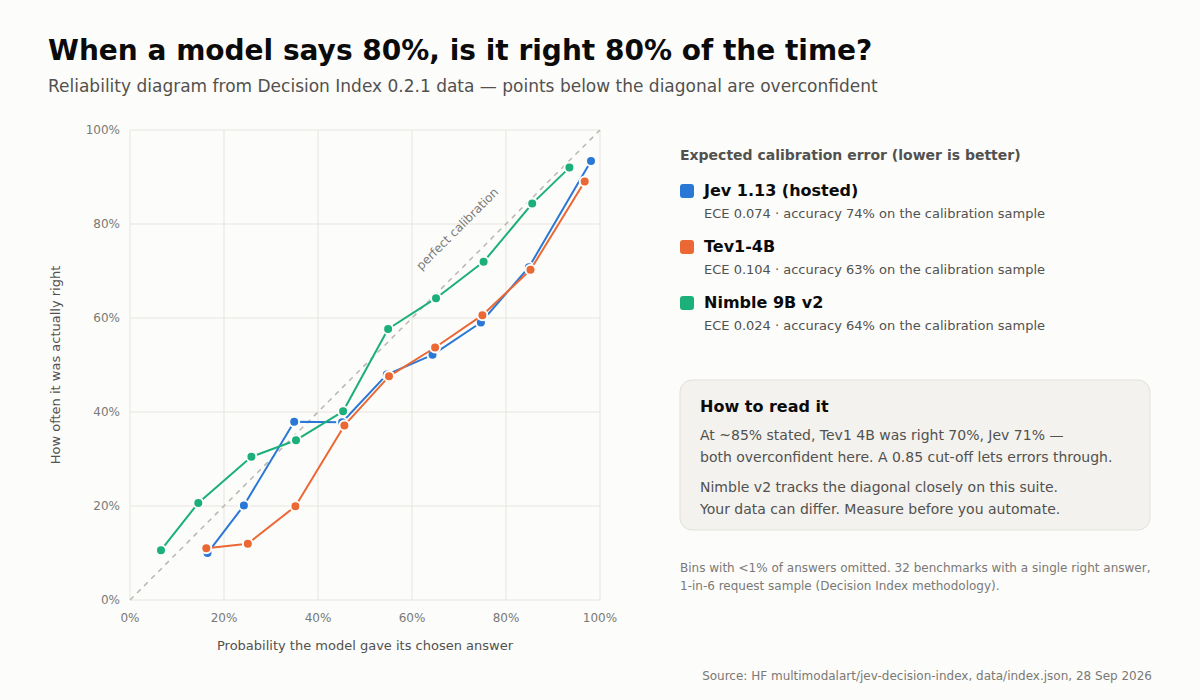
Group your test answers into bins by the probability of the chosen option (0.5–0.6, 0.6–0.7, …). In each bin, compute how often the model was right. A calibrated model's accuracy in the 0.8–0.9 bin is about 0.85. An overconfident model says 0.9 and is right 70% of the time — the common failure, and the dangerous one, because your code will auto-accept those answers.
The single-number summary is expected calibration error (ECE): the weighted average gap between stated probability and actual accuracy across bins. Lower is better. On the community Decision Index (snapshot 28 September 2026), Jev 1.13 has an ECE of 0.074; open models range from 0.014 (Jebadiah 27B) to above 0.5. A low ECE on a public benchmark is encouraging; it doesn't transfer automatically to your tickets, your policies, your language.
Measure it on your data — the 30-minute version
- Collect 100–300 real examples for one question. Real, not invented — invented examples are easier than production.
- Label them yourself (or two people, and discard disagreements).
- Run them through the model with the exact question wording you'll use in production.
- Compute accuracy, ECE and the accuracy-vs-coverage curve with the script below.
- Pick thresholds from the curve, then re-check on a fresh batch a month later.
Save your examples as JSON Lines, one decision per line:
{"state": "I was charged twice. Please refund the extra payment.", "label": "billing"}
{"state": "The app crashes when I open settings.", "label": "technical"}
Then run this against your local Ollama. It needs only requests:
# eval_decisions.py — measure accuracy and calibration of one choice question
# Usage: python eval_decisions.py examples.jsonl nimble
import json, sys, requests

URL = "http://localhost:11434/v1/systemone"
QUESTION = {
    "type": "choice",
    "instructions": "Which team should handle this ticket?",
    "criteria": {
        "billing": "Payments and refunds",
        "technical": "Bugs and integrations",
        "other": "None of the above",
    },
}

def run(path, model):
    rows = []
    with open(path, encoding="utf-8") as f:
        for line in f:
            ex = json.loads(line)
            r = requests.post(URL, json={
                "model": model,
                "state": ex["state"],
                "questions": {"q": QUESTION},
                "keep_alive": "10m",
            }, timeout=120)
            r.raise_for_status()
            a = r.json()["answers"]["q"]
            p = a["probabilities"][a["choice"]]
            rows.append((p, a["choice"] == ex["label"]))
    return rows

def ece(rows, bins=10):
    total, err = len(rows), 0.0
    for b in range(bins):
        lo, hi = b / bins, (b + 1) / bins
        in_bin = [(p, ok) for p, ok in rows if lo < p <= hi or (b == 0 and p == 0)]
        if not in_bin:
            continue
        conf = sum(p for p, _ in in_bin) / len(in_bin)
        acc = sum(ok for _, ok in in_bin) / len(in_bin)
        err += len(in_bin) / total * abs(conf - acc)
    return err

def coverage_curve(rows, thresholds=(0.5, 0.6, 0.7, 0.8, 0.9, 0.95)):
    for t in thresholds:
        kept = [ok for p, ok in rows if p >= t]
        cov = len(kept) / len(rows)
        acc = sum(kept) / len(kept) if kept else float("nan")
        print(f"accept if p >= {t:.2f}: covers {cov:6.1%} of traffic, accuracy {acc:6.1%}")

if __name__ == "__main__":
    rows = run(sys.argv[1], sys.argv[2] if len(sys.argv) > 2 else "nimble")
    acc = sum(ok for _, ok in rows) / len(rows)
    print(f"n={len(rows)}  accuracy={acc:.1%}  ECE={ece(rows):.3f}")
    coverage_curve(rows)
The output reads like this (illustrative numbers, not a measurement):
n=200  accuracy=86.0%  ECE=0.061
accept if p >= 0.50: covers 100.0% of traffic, accuracy  86.0%
accept if p >= 0.70: covers  88.5% of traffic, accuracy  92.1%
accept if p >= 0.90: covers  71.0% of traffic, accuracy  97.2%
accept if p >= 0.95: covers  58.5% of traffic, accuracy  98.3%
That last table is the whole decision: "if I auto-accept everything above 0.9, I handle 71% of tickets automatically at 97% accuracy, and a human sees the other 29%." Whether 97% is good enough is a business question, not a model question.
Set three bands, not one threshold
p ≥ accept_threshold          → act automatically
review ≤ p < accept_threshold → escalate: bigger model, second opinion, or a human
p < review → abstain: don't guess; fall back to the safe default- Per question, per type. A threshold tuned on a
nouldoesn't carry over to achoice, even on the same topic — TypeSafe documents that a model's answer to a question and to its reworded opposite don't necessarily sum to 1. - Escalate cheaply. Run
tev1first; send only the uncertain band tonimbleor an open 27B reproduction; send what's still uncertain to a human. Most traffic never touches the big model. - Use margin for
choice. The gap between the top two probabilities is often a better escalation signal than the top probability alone, especially with many options. - Read
scorecarefully.scoreis a weighted average of level indices, so a 0.9 on a three-level scale can come from a model split between levels 0 and 2 — look atprobabilitiesbefore acting on it. Score is also the weakest primitive: Nimble scores 54.6% on it versus about 80% on choice and yes/no in Bespoke's public benchmark.
Things that change probabilities without changing answers
- Temperature. Some model repos ship a calibration temperature (Bespoke's original Nimble checkpoint used T = 2.179, its September checkpoint T = 1.0; Decider applies a separate temperature per answer type). Temperature reshapes the probabilities but never changes which option is highest. Re-tune your thresholds whenever you switch model version or runtime.
- Quantisation. A Q4 build can pick the same answers as BF16 and still shift the probabilities. JevK5's card reports its Q4_K_M build matching BF16 answers on 221 of 231 public items — close, not identical. Measure on the build you'll run.
- Wording. Option descriptions carry the meaning. Question names are labels for your code — Decider, for one, never shows them to the model. If you leave an option's description
null, Ollama uses the key itself as the option text, so"billing": nullis weaker than"billing": "Payments, invoices and refunds".
Frequently asked questions
Is a high confidence in Ollama a good sign?
It means the model strongly favours one option. That's necessary for a trustworthy answer but not sufficient: a model can be confidently wrong. Measure calibration on your data before you use it as an automation threshold.
How many examples do I need?
100 labelled examples gives you a rough accuracy number; 300 or more lets you see calibration per bin. Add more for rare but costly cases — refund fraud, safety violations — because an overall accuracy number hides them.
Should I trust the ECE numbers on model cards and leaderboards?
They're useful for comparing models on the same benchmark. They don't predict calibration on your distribution. A model trained on customer-support tickets can be well calibrated there and overconfident on legal clauses.
Can I recalibrate a model myself?
Yes. The simplest method is temperature scaling: fit one number on your labelled set that rescales the probabilities to match observed accuracy. Several open decision models ship exactly that as a config value. It improves calibration without changing any answer. --- Definitions from docs.ollama.com/api/systemone and /capabilities/decision; failure modes from TypeSafe's jev-1.13 model jaggedness page; model figures from the Bespoke Nimble README and the Decision Index 0.2.1 data. Read 30 September 2026.